In 2025 a single 20 kg lot of washed Geisha from Hacienda La Esmeralda sold at the Best of Panama auction for US$30,204 a kilo, just under US$605,000 for the lot (Sprudge). The same farm had set an auction record with Geisha 21 years earlier, at a price reported as US$21 a pound. For most of the time between Ethiopia and Boquete, nobody grew this tree for its taste.
From Gesha to Turrialba
The variety takes its name from the Gesha region of south-western Ethiopia, where seeds were collected in 1936. In 1953 the seeds reached CATIE, the agricultural research centre in Turrialba, Costa Rica, which catalogued them as accession T2722 and distributed the plant across Central America (Wikipedia).
Panama planted it from the 1960s, Boquete included. Farmers wanted it because it tolerated coffee leaf rust, and flavour was not part of the reason. Geisha is a tall plant with low yields, so on a farm paid by the quintal it had little else in its favour.
You will see two spellings on bags from the same valley. Finca Dos Jefes in Boquete sells a Gesha; Janson in Volcán sells a Geisha. Both are the same variety.
The Petersons and the Jaramillo trees
Rudolph A. Peterson bought Hacienda La Esmeralda in 1967. His family moved into coffee in the mid-1980s and in 1997 bought land at Jaramillo, higher on the Boquete slopes (Hacienda La Esmeralda).
Then rust came through the farm. Daniel Peterson noticed that the Geisha trees on Jaramillo held up better than the others, so the family planted more of them there, above 1,650 m. By the estate’s own account the decision was about keeping trees alive.
In 2004 the Petersons kept a lot of 100% Geisha from Jaramillo separate and entered it in Best of Panama, the national competition and auction. It won, and it sold for a record price at the time, reported as US$21 a pound (Hacienda La Esmeralda, Wikipedia). A washed Geisha often smells of jasmine and tastes of citrus and bergamot.
Twenty years of wins
Esmeralda’s washed Geisha won Best of Panama again in 2005, 2006, 2007, 2009 and 2010, and once more in 2025 (Hacienda La Esmeralda). By 2017 its top lot sold for US$601 a pound (Daily Coffee News).
Other Boquete farms planted Geisha and entered too. Elida Estate, run by the Lamastus family in Los Naranjos, sold the top lot in 2018 with a natural Geisha at US$803 a pound (Daily Coffee News), again in 2019 at US$1,029 a pound (Daily Coffee News), in 2024 (Daily Coffee News), and in 2026 with Elida Geisha Torre at US$18,004 a kilo (Newsroom Panama).
Esmeralda was not the only Boquete family with early seed. Tourism Panama credits the Serracín family of Don Pachi Estate, also in Los Naranjos, with bringing early Geisha seed to Boquete (Tourism Panama).
The competition now runs on Geisha. The 30th Best of Panama, in 2026, drew 102 lots from 47 producers: 35 washed Geisha, 35 natural Geisha and 32 other varieties (La Estrella de Panamá). That is 70 Geisha lots out of 102. Geisha from outside Boquete has topped the auction too, from Nuguo in Renacimiento in 2021 and Carmen Estates near Volcán in 2023. The auction price history has the year-by-year numbers.
Where the trees grow
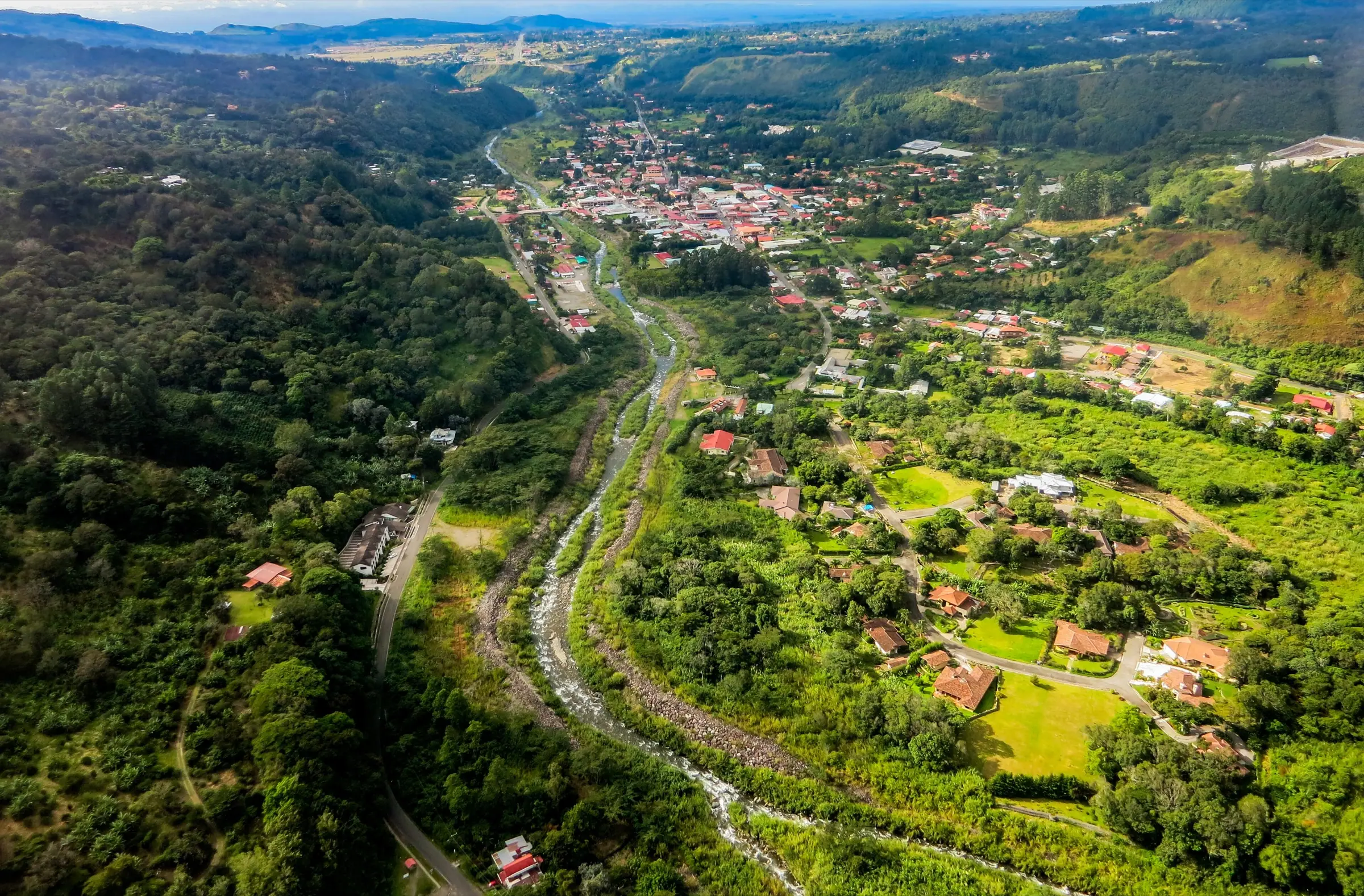
Boquete’s coffee circuit farms sit between 1,000 and 2,100 m above sea level (Tourism Panama). Esmeralda planted its Geisha above 1,650 m. Elida’s highest tour, La Torre, drives up through lots above 1,900 m (Lamastus Family Estates). The Boquete side of Volcán Barú is cool, roughly 14 to 22 C, and from December to March a fine wind-driven mist called bajareque blows through the valley. The Boquete region page covers the roads in and the harvest months.
Tasting it in Boquete
Hacienda La Esmeralda accepts trade visits only, so to taste Geisha on a farm you go to a neighbour. Four farms with tours put it on the table:
- Elida Estate runs a cupping for US$30 a person (minimum two), a farm walk with a mill visit for US$45, and La Torre for US$75, which drives up through the high lots. See the Elida page.
- Finca Dos Jefes ends its 2.5-hour tour, daily at 9:00 and 14:00, with three coffees including a light-roast Gesha. US$35 a person, cash only (Finca Dos Jefes). See the Dos Jefes page.
- Altieri Specialty Coffee pours three profiles including Geisha on its Geney Boy tour, US$50 for 1.5 hours (Altieri). See the Altieri page.
- Finca Lérida runs an Exclusive Geisha Coffee Experience, price on request. Its Waterfall Geisha Natural sold for US$13,505 a kilo in 2026, the second-highest price of that auction (Newsroom Panama). See the Lérida page.
Each farm page has a request form. Dorien checks the date with the farm and replies by email within 48 hours, and you pay the farm on the day.
To taste Esmeralda’s own coffee, the estate shop sells a roasted Geisha microlot assortment for US$220 (November 2026). It is listed with the other farm-direct beans in the shop.
Sources
- Geisha (coffee), Wikipedia
- Our story, Hacienda La Esmeralda
- Hacienda La Esmeralda, home page (Best of Panama wins)
- A Panama Gesha broke price records again, Sprudge (2025)
- Best of Panama shatters price records, Daily Coffee News (2024)
- Natural Geisha breaks Best of Panama auction record at $803 per pound, Daily Coffee News (2018)
- Elida Estate Gesha earns $1,029 per pound, Daily Coffee News (2019)
- US$18,000 per kilo at the Best of Panama auction, Newsroom Panama (2026)
- Variabilidad climática reduce la cosecha del café geisha, La Estrella de Panamá
- Coffee circuit in Boquete: coffee farms to visit, Tourism Panama
- Tours at Elida, Lamastus Family Estates
- Coffee tours, Finca Dos Jefes
- Experiencias, Altieri Specialty Coffee
Written by CoffeePana from the sources above. Prices and times were checked in November 2026; farms change them, so confirm before you travel. If you spot an error, email a correction.